
The Scenic Route: What You'll Actually See on the Pokhara to Chitwan Bus Journey
Oct 09, 2026
If you have booked a Pokhara to Chitwan bus, you probably already know the basics: roughly 135 km, around 4 to 5 hours on the road, and a morning departure.
But what does the journey actually look like?
That is the part most travel guides skip.
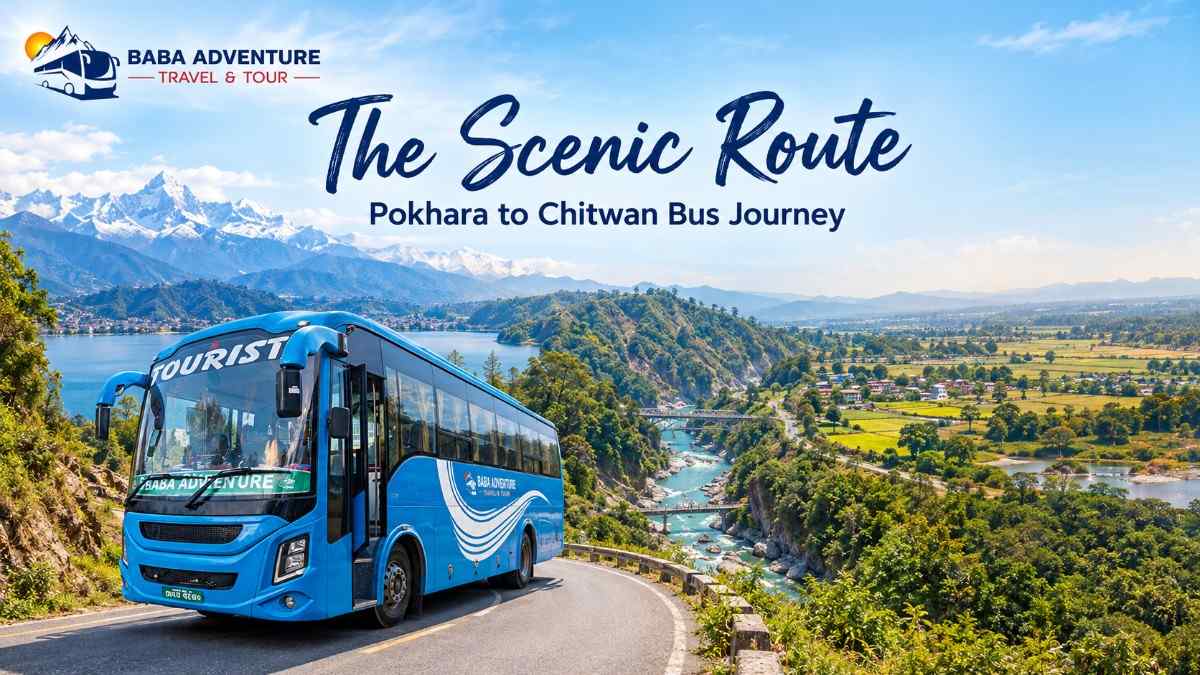
The road from Pokhara to Chitwan is more than simply a way to get from one destination to another. Over the course of a few hours, the landscape changes from lakes and mountain views to winding hills, river valleys, farmland, and finally the warmer lowlands around Chitwan.
So, if you're wondering whether there is anything worth looking at from the bus window, the answer is yes. Here's what you can expect along the way.
Quick Answer: The Pokhara to Chitwan bus covers 135 km in about 4 to 5 hours, running from Pokhara through Mugling and Bharatpur to Sauraha. Baba Adventure's daily service leaves at 7:30 AM on a 2x2 luxurious sofa seat bus, and a ticket costs Rs 900 per person. Book through the eSewa app to get Rs 100 cashback, or pay with Fonepay for 2% cashback (offers can change, so check at checkout).
What Will You See on the Pokhara to Chitwan Bus?
The Pokhara to Chitwan bus takes you through several very different landscapes in a single journey.
Leaving Pokhara, you'll see the hills around the valley and, depending on the weather, some of the mountains in the distance. As the road continues towards Mugling, the scenery becomes greener and more dramatic, with winding roads, hillsides, small settlements, and river sections along the way.
After Mugling, the landscape gradually opens up. The hills become less dramatic as you approach Bharatpur, and you will start seeing more farmland and villages. Eventually, the trees become thicker as you approach Chitwan and the lowland landscape around Sauraha.
It is a surprisingly varied journey for a four to five-hour bus ride.
Can You Still See Phewa Lake Pokhara as the Bus Pulls Out?
Probably not. The bus leaves through Pokhara’s city roads, so you’re unlikely to see Phewa Lake itself once you’re underway
On a clear morning, though, you may catch the surrounding hills and some Annapurna views as the bus leaves Pokhara, before the road moves away from the familiar Pokhara landscape
The first part of the journey feels relatively urban, with roadside shops, smaller settlements, motorbikes, and local traffic. Gradually, though, the buildings become less frequent and the road begins to wind through greener surroundings.
Why Are the River Sections Around Mugling the Highlight of the Ride?
For many passengers, the river sections around Mugling, where the Marsyangdi and Trishuli rivers meet, are the most memorable part of the journey.
The road winds through green hills, and at different points the river appears below or alongside the highway. The combination of steep hills, flowing water, bridges, and roadside settlements gives this section a very different character from the road you have just left behind in Pokhara.
Keep your camera ready for:
-
The Marsyangdi and Trishuli rivers, with their turquoise-grey water
-
Suspension bridges crossing the river
-
You may spot Trishuli river rafting groups on the water
-
Small settlements along the river
-
Green hills and farmland spread across the slopes
This is one section where having a window seat really makes a difference.
What Happens at the Halfway Stop in Mugling, Nepal?
Around the middle of the journey, you'll reach Mugling, Nepal, an important road junction where several major routes meet.
Mugling itself is much busier than the quieter stretches of road before it. You'll see restaurants, shops, buses, trucks, and plenty of roadside activity.
For passengers, it is also a useful break. The bus makes a scheduled stop here, giving you time to stretch your legs, use the restroom, or pick up a snack before continuing towards Chitwan.
What Changes Once You Pass Mugling and Reach Bharatpur, Nepal?
After Mugling, the road gradually leaves the more dramatic hill landscape behind.
As you move towards Bharatpur, Nepal, the terrain becomes flatter and the views become more open. Instead of steep hills on either side, you'll see farmland, villages, fields, livestock, and wider stretches of road.
The exact scenery changes with the season. Depending on when you travel, you may see cultivated fields, mustard (around December to February), rice paddies (roughly June to October), or grazing animals.
You may also notice the weather becoming warmer as you move towards the Chitwan lowlands.
It is a subtle change at first, but by this point the landscape feels very different from the cooler hills around Pokhara.
How Will You Know You're Close to Sauraha, Chitwan?
The landscape begins to change as you get closer to Sauraha, Chitwan.
There are more trees, the surroundings feel greener, and the lowland atmosphere becomes much more noticeable. You may also pass through villages and see traditional houses and everyday rural life along the road.
This is the point where you know Chitwan is getting close.
The area around Chitwan National Park is famous for its forests and wildlife, but you don't have to wait until your safari to start appreciating the landscape. Even from the bus window, the thicker vegetation and warmer surroundings give you a first impression of the region.
By the time you reach Sauraha Bus Park, you've travelled from the lakeside hills of Pokhara into the warmer plains of Chitwan.
Does Your Seat Matter for the Views?
Not really. The road bends, and the rivers, hills, and villages appear on different sides at different points, so there’s something to see from either side of the bus.
The river sections around Mugling are the highlight, so that’s the part to have your camera ready for.
If photography is your priority, a window seat is definitely worth requesting when booking.
What Might Be Watching You From the Roadside?
Don't expect a full wildlife experience from the bus. That's what a proper Chitwan jungle safari is for.
Still, the road passes through enough rural and forested areas that you may notice some wildlife or animals along the way.
You could see:
-
Langur monkeys in the trees
-
Water buffalo and cattle around farmland
-
Egrets and herons near water
None of these sightings are guaranteed, of course. It depends on the season, weather, time of day, and simply a bit of luck.
But that's part of the fun of travelling by road. You never quite know what you'll see through the window.
Morning Light or Golden Hour: When Should You Travel?
Your departure time can make a difference to the experience.
An early morning departure, such as the standard 7:30 AM service, means you'll travel through the hill section while temperatures are still relatively comfortable. Morning light can also make the river and surrounding hills look particularly clear when the weather cooperates.
By midday, visibility can sometimes become hazier, especially across the warmer lowland areas.
Later in the day, the Chitwan landscape can take on warmer afternoon light, although you'll have less daylight for the earlier sections of the route.
If scenery is your main priority, an early departure is a good choice.
What Does the Route Look Like in Monsoon and Winter?
The season you travel in makes a real difference to what you see from the window.
-
Monsoon (June to September): The hills are at their greenest, and the rivers run high and muddy. Clouds often hide the mountains, and heavy rain can cause landslides or traffic delays on the highway, so the 4- 5 hour journey can take longer than usual. It’s worth checking road conditions before you travel.
-
Winter (December to February): Skies are generally clearer, which gives you the best chance of mountain views around Pokhara. Mornings are cool, mustard fields can be in flower on the plains near Bharatpur, and fog is possible in the lowlands early in the day.
Window Seat Ready: What Should You Actually Bring?
You don't need much for this journey, but a few simple things can make the ride more comfortable.
-
A window seat, if available
-
Sunglasses for the brighter sections of the route
-
Your phone or camera for photographs
-
Extra battery or a power bank
-
Motion sickness medication if winding roads affect you
-
A light jacket for the cooler hill sections
And don't spend the entire journey looking at your phone.
Some of the best parts of the route are the moments you don't plan for a river suddenly appearing below the road, a suspension bridge in the distance, or a small village tucked into the hills.
Is the Pokhara to Chitwan Bus Better Than Flying?
If getting there as quickly as possible is your only priority, flying will naturally be faster.
But that also means missing the journey itself.
A flight takes you above the landscape. The Pokhara to Chitwan bus takes you through it.
From the hills around Pokhara to the Marsyangdi and Trishuli rivers around Mugling, then the farmland around Bharatpur, and finally towards the forests of Chitwan, you get to see how dramatically Nepal's landscape changes over a relatively short distance.
For travellers who enjoy road journeys, that is a big part of the appeal.
You're not just travelling to Chitwan. You're getting to see the country change along the way.
Want More Control Over Your Stops? Try a Private Vehicle
A tourist bus works well if you want a straightforward journey on a fixed schedule.
But what if you want to stop for photographs, spend more time beside the river, or leave at a time that suits your group?
A private vehicle gives you much more flexibility.
Baba Adventure offers cars, jeeps, Hiace vans, and tourist coasters for travellers who want more control over the journey.
A private vehicle can make sense if:
-
You're travelling with family or a group
-
You want to stop for photographs
-
You prefer a flexible departure time
-
You have extra luggage or equipment
-
You want more privacy during the journey
A private vehicle costs more than an individual bus ticket, but groups can split the cost between passengers. You also get the advantage of choosing when and where to stop.
You can check the available options for car rental, jeep rental, or Hiace rental Nepal.
Who's Actually Driving You Through All This?
Baba Adventure has been operating daily tourist bus services on this route since 2009.
The service offers a comfortable daytime journey with spacious 2x2 luxury sofa seating and a scheduled stop at Mugling, so you can sit back, take in the scenery, and enjoy a relaxed ride.
The Pokhara to Chitwan route is one of those journeys that makes more sense once you've actually seen it.
The route begins with Pokhara’s mountain views before taking you through winding hill roads and along the rivers near Mugling. After passing Mugling, the scenery opens into the plains around Bharatpur, gradually becoming greener as you get closer to Chitwan.
Tickets are Rs 900 per person. Book through the eSewa app for Rs 100 cashback, or pay with Fonepay for 2% cashback (offers can change, so check at checkout).
If you're ready to make the journey yourself, you can check the Chitwan to Pokhara Tourist Bus guide (the same route in the reverse direction) for route and service information, or go directly to the Pokhara to Chitwan Tourist Bus Ticket page to check the current details and book your seat.
FAQs
What time does the Pokhara to Chitwan bus leave?
The daily Pokhara to Chitwan bus departs at 7:30 AM, giving you a full daytime journey to enjoy the changing scenery along the route.
How much does the Pokhara to Chitwan bus ticket cost?
The ticket costs Rs 900 per person for a comfortable 2x2 luxurious sofa seat. Fares may vary, so it’s best to check the booking page for the latest price on your travel date.
Is the Pokhara to Chitwan bus ride scenic the whole way?
Most of the journey offers something to look at, although the scenery changes. The hill and river section is the most dramatic, while the areas around Bharatpur are flatter and more focused on farmland and villages.
Will I get good photos from the bus window?
Yes. The river and hill sections offer some of the best opportunities. A window seat is worth requesting if photography is important to you.
Does the bus stop anywhere during the ride?
Yes. The bus makes a scheduled stop around Mugling, roughly halfway through the journey, where passengers can stretch, use the restroom, or get something to eat
Is Baba Adventure’s bus the one that runs this route?
Yes. Baba Adventure runs a daily Pokhara to Chitwan tourist bus service on this route.
Does my seat affect the views?
Not really. The rivers and hills appear on different sides at different points along the route, so there’s something to see from either side. The river sections around Mugling are the highlight, and once you reach the flatter areas, the views open up on both sides.
Will I see wildlife on the way to Chitwan?
You may spot a few animals along the way, especially around the greener stretches of the route. Keep an eye out for langur monkeys, water buffalo, cattle, and birds. There’s no guarantee of a sighting, but it’s worth keeping your camera ready as you get closer to Chitwan.
Contact us Directly
If you want to contact us immediately, please give us a ring on the given number.